

Детали
BAUHAUS MOVEMENT · OBJECT & CONTEXT
Bauhaus Chess · Strategy in pure form
Josef Hartwig reduced chess to its essentials: movement becomes form. Each piece is designed so you can intuitively “read” its logic. No ornament. No historical costume. Only geometry.
That is the Bauhaus DNA: clarity in service of the player, function as the measure, and an object that does not decorate — it explains.
EDITORIAL KEY
Form follows move
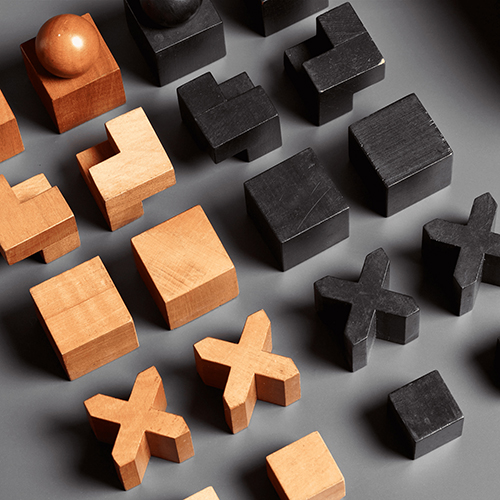
Josef Hartwig translated chess into a readable system. The shapes are not driven by symbolism or tradition, but solely by how each piece moves on the board.
The rook becomes a cube, the bishop a diagonal cross, and the knight an L-form. Each piece explains itself through function. You don’t have to know it — you can understand it.
This is the radical core of the design. Bauhaus Chess is not a decorative object, but a model for thinking: design as a method to make rules visible and to organise complexity.
Board, pieces, and space form a closed system — not to be interpreted, but to be read.
Experience Bauhaus live · Bauhaus ExperienceQuick profile
Hartwig’s Bauhaus Chess (Weimar, 1923) is not a “decorative” game object, but a didactic model: it invites you to read chess. Instead of historical symbolism, Hartwig uses geometry that is directly linked to movement logic. Chess is not made simpler — but more legible, because form becomes instruction.
The principle is consistent: each piece is constructed so that direction and range become “visible” in the body. Rook and bishop can be understood as straight line and diagonal; the knight as an L-move. This reduction is Bauhaus at its core: method before style, clarity before ornament, function as the measure.
The relationship to the board matters, too: the pieces do not “perform” contrast — they harmonise with the grid logic of the playing surface as a closed system. The result feels like small-scale architecture: strict, calm, modular. The message is quiet, yet precise: design can carry knowledge — without explanatory text, purely through form.
If you are looking at an authorised modern edition today, it is helpful to distinguish: the design dates to 1923, while later editions are produced as re-editions/remakes (e.g., by Naef). This is why collectors and museums often separate the historic design context from later manufacture.
- Design: Josef Hartwig, Bauhaus Weimar, 1923.
- Principle: movement logic becomes form (geometry as instruction).
- Didactics: object as learning system, not an illustration of rank or history.
- Aesthetics: strict harmony with the board grid; “small architecture” in scale.
- Editions: later re-editions/remakes (e.g., Naef) differ from the historical design context.
Design & function
Hartwig does not try to “reinvent” chess — he makes it more legible. Each piece has a specific form and presence, so you can grasp movement and value faster. The result is chess as method: reduced, clear, repeatable.
- Simplicity: fewer signs, more meaning.
- Functionality: form supports the game, not decoration.
- Systems thinking: pieces, board, and proportions act as one.
- Innovative aesthetics: beauty emerges from clarity and consistency.
Cultural & historical context
At the Bauhaus, design was not a “style” — it was a method. Things were broken down into parts, examined for purpose, material, making, and use — and then rebuilt into a form that can explain itself. That is why many Bauhaus objects feel so natural today: they are not meant to impress, but to work — and to be understood.
Hartwig’s chess set takes this attitude seriously. It translates a culturally loaded game — kings, crowns, tradition — into neutral, readable geometry. The pieces do not tell a story of rank; they show rules. You recognise movement not through symbolism, but through structure. Complexity does not shrink — orientation becomes clearer.
This also changes the role of the player: you don’t only look — you read. The set trains attention, proportion, and order — like a small didactic model. It fits the Bauhaus belief that learning can happen through objects: through handling, scale, and systematic difference.
And one more thing becomes visible: Bauhaus reduction is not “less for the sake of less”. It is a decision for legibility. In Hartwig’s chess, form becomes communication — calm, consistent, without gesture. That consistency is exactly what keeps the object modern today.
- Method over style: the object results from a clear design process.
- Rules over symbolism: forms explain movement, not decoration.
- Learning through the object: play becomes training in systems thinking.
Answers to key questions
What is Bauhaus Chess?
A chess set built on Bauhaus logic: pieces are designed as geometric functional forms, so you can recognise movement more quickly. It is both a playable object and a teaching model.
Who designed Bauhaus Chess?
Josef Hartwig. The design comes from the Bauhaus context (Weimar, 1923) and is famous for translating movement into form.
Why are the pieces so reduced?
Because ornament is not the task. The shapes are meant to show how each piece moves. You read the game through geometry, not through symbolic figurines.
Is the set meant for play?
Yes. It is fully playable, and it also reads as a sculptural object when at rest. This dual role fits Bauhaus thinking: use and form as one.
FAQ
Is this an authorised edition?
Yes. Naef produces the set under an official Bauhaus licence and numbers each box. A certificate is included with the edition.
What materials are used?
Solid maple wood with a satin-matt finish. The precise surface supports the clear legibility of the forms.
Is the set suitable for children?
Yes. Robust wooden pieces, recommended from age 6+. For younger children, the rules are often the bigger hurdle than the material.
What are the board and square dimensions?
Board approx. 36 cm (14″), square approx. 4.5 cm (1.75″). For exact details, please refer to the product attributes.
Video context
Experience Bauhaus Chess in context
Bauhaus Chess reveals its full meaning in spatial context — between architecture, teaching, objects, and the thinking that produced it. In a museum setting, it becomes clear why this game was not merely designed, but deliberately constructed.
You can see how Bauhaus objects belong to a larger system — connected to workshops, curriculum, living models, and a clear attitude toward function and society. Chess shifts from a single object to a key for understanding Bauhaus as method.
Bauhaus Movement provides the object, knowledge, and context layer. Bauhaus Experience leads you to the places where Bauhaus thinking becomes tangible — and where objects can be read in the interplay of architecture, collections, and everyday life.
Bauhaus Movement provides context and objects. Travel programs and curated itineraries are hosted on Bauhaus Experience.